The Death of Google Search: How the World’s Most Trusted Search Engine Lost Its Way in 2026
Introduction
The death of Google Search is no longer a prediction—it’s happening right before our eyes in 2026. If you’re a digital marketer, content creator, business owner, or simply someone who uses the internet daily, this article will fundamentally change how you think about online search.
Remember when Google felt like pure magic? You typed a question, pressed enter, and within milliseconds, you had exactly what you needed. No clutter, no confusion—just relevant, trustworthy information at your fingertips.
But fast forward to 2026, and the experience is drastically different. Your screen overflows with ads indistinguishable from organic results. AI-generated junk content dominates rankings. And millions of users now instinctively add “Reddit” to every search query just to find authentic human responses.
In this comprehensive guide, we’ll explore how Google Search transformed from a revolutionary tool to a declining platform, what forces accelerated this collapse, and what the future of online search looks like as we move through 2026 and beyond.
How Google Revolutionized Internet Search
The Internet Before Google: A Digital Wild West
To truly understand the death of Google Search in 2026, you need to appreciate what the internet looked like before Google existed.
In the mid-1990s, the World Wide Web was expanding explosively, but finding information was incredibly frustrating. Imagine a massive library containing millions of books but with absolutely no catalog system—no way to find anything except by wandering through endless shelves. That’s exactly what the early internet felt like.
Early Navigation Tools:
- Web Directories (like Yahoo Directory): These weren’t search engines in any modern sense—they were human-curated lists of websites organized into categories. Want to find chess-related content? You’d navigate through Recreation → Games → Board Games → Chess. It functioned, but it was painfully slow and couldn’t keep pace with the web’s explosive growth.
- First-Generation Search Engines (like AltaVista): These represented significant progress, indexing millions of pages. However, they had a critical flaw: no quality filter whatsoever. Search for anything, and you’d receive thousands of results with no reliable way to determine which ones were actually useful. The most relevant result might be buried on page 50 or beyond.
- Web Rings: Groups of related websites linked together in a circular pattern. Finding quality content was possible but largely accidental—you stumbled upon good information rather than discovering it systematically.
The core problem wasn’t merely technical—it was deeply psychological. Users desperately wanted a tool that didn’t just locate pages containing their keywords but actually understood what those pages meant and which ones deserved their trust.
The PageRank Revolution: Google’s Genius Innovation
In 1996, two Stanford PhD students—Larry Page and Sergey Brin—were working on a research project that would fundamentally reshape the internet.
While existing search engines focused exclusively on analyzing content displayed on individual web pages, Page and Brin developed a radically different approach: What if instead of examining what a page claims about itself, we analyzed what the entire rest of the web says about that page?
This breakthrough insight led to the creation of PageRank, arguably the most important algorithm in internet history.
How PageRank Worked:
| Concept | Explanation |
|---|---|
| Links as Votes | Every hyperlink pointing to a page counted as a vote of confidence from another website |
| Vote Quality Matters | A link from Harvard.edu or The New York Times carried significantly more weight than a link from an unknown personal blog |
| Recursive Calculation | The system calculated importance scores by analyzing both the quantity and quality of incoming links across the entire web |
| Authority is Earned | Websites couldn’t simply claim to be authoritative—they had to earn recognition through genuine endorsement from other trusted sources |
This approach was revolutionary because it leveraged the collective intelligence of the entire web. When respected institutions, major news outlets, established experts, or government agencies linked to a page, that page rose in rankings—not because it claimed to be important, but because others recognized its value.
Google’s Early Promise: “Don’t Be Evil”
What made early Google truly extraordinary wasn’t just its superior technology—it was its philosophy and ethical commitment.
The company’s official mission was remarkably ambitious: “To organize the world’s information and make it universally accessible and useful.”
Their informal motto, “Don’t Be Evil,” reportedly started as an internal joke but evolved into a genuine differentiator that shaped company culture. At a time when competitors were already exploiting users with cluttered, ad-heavy, confusing interfaces, Google promised something fundamentally different.
Google’s 2004 Founder’s Letter to Shareholders included explicit, written commitments:
- Search results would remain permanently unbiased
- The company would never accept payment to artificially rank pages higher
- User trust was considered more valuable than short-term revenue
- Advertising would always be clearly distinguished from organic content
And you could observe these promises reflected directly in the product experience:
- Clean, minimalist interface: Just a simple white box on a white page—no clutter, no distractions
- Clear ad labeling: Sponsored links appeared in a distinctly separate colored box positioned on the side of the page
- Remarkable speed: Results appeared in under a second, often in milliseconds
- Genuine accuracy: PageRank delivered truly relevant, trustworthy results
For the first time in internet history, users felt genuine control and trust. The magic that millions had been desperately waiting for was finally here.
The Ad Invasion: How Google Monetized Your Trust
The Introduction of AdWords (2000)
The death of Google Search began with a gradual but deliberate erosion of the wall separating advertising from organic content—a wall Google had explicitly promised to maintain.
In 2000, Google introduced AdWords, a self-service advertising platform that would eventually become one of the most profitable products in global business history, generating over $200 billion annually by 2025.
Initially, Google genuinely honored its “Don’t Be Evil” promise. Advertisements were kept in a clearly defined sandbox—a visually distinct colored box positioned on the side of the page, explicitly and prominently labeled “Sponsored Links.” Organic results remained completely untouched, trustworthy, and clearly separate.
But as Google’s market power grew and Wall Street’s relentless pressure for quarterly earnings intensified, that crucial separation began to blur, then fade, then virtually disappear.
The Slow Erosion of Trust: A Complete Timeline
| Year | Change Implemented | Impact on Users |
|---|---|---|
| 2000 | AdWords launches with ads confined to side column | Clear visual and spatial separation maintained |
| 2007 | Ads migrate from side position to top of page | Advertisements now appear before organic results |
| 2010 | Colored background behind ads begins fading | Visual distinction between ads and content weakens |
| 2013 | Background box removed entirely | Only a small yellow “Ad” label remains as identifier |
| 2016 | Side ads eliminated completely, more top ads added | Up to 4 advertisements appear before any organic result |
| 2019 | Yellow “Ad” label redesigned to blend with content | Deliberately designed to appear like organic results |
| 2022 | Shopping carousels and sponsored content expand | Even more screen real estate dedicated to paid placement |
| 2024 | Entire above-fold screen dominated by various ad formats | Users must scroll significantly to reach organic content |
| 2025 | AI-generated ad formats blur lines further | Near-impossible to distinguish paid from organic content |
| 2026 | Current state: ads virtually indistinguishable from results | User trust at historic lows; alternative platforms surge |
The Deliberate Design Choice
This evolution wasn’t accidental or the result of innocent optimization—it was a calculated, extensively tested design decision with one clear objective: get users to click on advertisements without consciously realizing they’re clicking on advertisements.
Every single change was rigorously A/B tested across millions of users. The gradual fading of visual distinctions between ads and organic results was specifically optimized to maximize click-through rates while minimizing user awareness that they were clicking paid content.
The Fundamental Philosophical Betrayal:
PageRank was built on the foundational idea of trust—that links represented genuine human endorsement and organic recognition. Advertising exists specifically to purchase relevance and visibility. When the line between earned relevance and purchased relevance systematically blurred, Google essentially commodified and sold the trust it had spent years carefully building.
This was the first major crack in Google’s crown—and it would only widen in the years ahead.
The SEO Wars: Gaming the Algorithm
The Rise of Search Engine Optimization
Because Google became the internet’s dominant front door, controlling approximately 92% of global search traffic at its peak, it inadvertently created a multi-billion dollar industry: Search Engine Optimization (SEO).
Initially, SEO represented a genuinely positive development. It helped website owners:
- Structure their content properly using clear headings and logical organization
- Implement clear metadata that accurately described page content
- Write in ways that Google’s crawlers could efficiently understand and categorize
- Improve overall user experience through faster loading times and mobile optimization
But where there’s a valuable system, there are inevitably people attempting to game it—and the SEO industry quickly developed a darker side.
White Hat vs. Black Hat SEO
| Approach | Primary Methods | Ultimate Goal |
|---|---|---|
| White Hat SEO | Quality content creation, proper technical structure, genuine relationship-based link building, user experience optimization | Help users discover genuinely valuable, relevant content |
| Black Hat SEO | Keyword stuffing, link farms, hidden text, cloaking, AI-generated spam, purchased links | Trick algorithm for higher rankings regardless of content quality |
Common Black Hat Techniques That Polluted Search Results:
- Keyword Stuffing: Filling pages with hundreds of hidden or visible keywords to artificially rank for multiple unrelated queries
- Link Farms: Elaborate networks of fake websites linking to each other solely to artificially inflate PageRank scores
- Content Spinning: Using software to automatically rewrite existing content to appear superficially original while adding no value
- Cloaking: Showing completely different content to Google’s crawlers than to human visitors
- Private Blog Networks (PBNs): Purchasing expired domains with existing authority to create fake link sources
The Content Farm Era
The real problem wasn’t individual black hat practitioners operating in isolation—it was the systematic industrialization of mediocrity at massive scale.
Companies like Demand Media (owner of eHow) discovered they could:
- Use Google’s own publicly available search data to identify exactly what millions of people were searching for
- Hire thousands of freelance writers at minimal rates ($15-25 per article, sometimes less)
- Produce tens of thousands of low-quality articles optimized purely for ranking, not for helping users
- Monetize the resulting traffic through strategically placed advertisements
Their goal was never to create the best or most genuinely informative content. The explicit goal was to create content that ranked well in search results and generated maximum ad revenue. Quality was irrelevant; ranking was everything.
The result? The internet progressively filled with thin, unhelpful, often misleading articles that technically answered search queries but provided minimal genuine value to actual human readers.
The AI Content Explosion (2023-2026)
If human-operated content farms were problematic, generative AI made the situation exponentially worse starting in late 2022 and accelerating dramatically through 2026.
With tools like ChatGPT, Claude, Gemini, and dozens of specialized AI writing platforms, producing low-quality, SEO-optimized content became virtually free and infinitely scalable. Websites could now generate:
- Hundreds or even thousands of articles per day with minimal human oversight
- Content that technically addressed questions but lacked genuine insight or expertise
- Material optimized purely for algorithm manipulation rather than reader value
- Often factually incorrect, outdated, or dangerously misleading information
By 2026, industry estimates suggest that over 60% of new content indexed by search engines is AI-generated, with the majority offering little to no genuine value beyond what the AI models were trained on.
Google officially states that using AI solely to manipulate search rankings violates their spam policies. But the ocean of AI-generated content has become so incomprehensibly vast that enforcing this policy is like attempting to empty the Pacific Ocean with a kitchen spoon.
The 2026 Result for Users:
Search results pages overwhelmingly filled with useless, repetitive, AI-generated content that all sounds eerily similar. Finding genuinely helpful, human-written, expert-verified information has become increasingly difficult—directly leading to the behavioral shifts we’ll examine next.
Enshittification: The Three-Stage Death of Digital Platforms
Understanding the Concept
The slow, deliberate decay we’ve been describing has a formal name in 2026 discourse: Enshittification.
Coined by writer and digital rights activist Cory Doctorow, this term describes the predictable, almost inevitable death pattern of digital platforms once they achieve market dominance.
The Three Stages of Enshittification
Stage 1: User Attraction (The Honeymoon Phase)
- Platform treats users exceptionally well, often exceeding expectations
- Provides excellent service, frequently operating at a financial loss
- Prioritizes user experience above all other considerations
- Goal: Attract massive audience, build dependency, and establish market dominance
This was Google’s early phase (1998-2008)—clean interface, remarkably accurate results, genuine usefulness, and a product that truly felt like magic.
Stage 2: User Exploitation for Business Customers (The Extraction Phase)
- Platform begins systematically degrading user experience
- Changes increasingly benefit advertisers and business clients at users’ expense
- User value and attention extracted to serve commercial interests
- Ads become more prominent; organic results become less useful
This was Google’s middle phase (2008-2020)—progressive blurring of lines between ads and content, prioritizing revenue over relevance, degrading the core search experience.
Stage 3: Business Customer Exploitation (The Squeeze Phase)
- Once advertisers and businesses are locked in with no viable alternatives
- Platform squeezes maximum value from everyone to benefit shareholders
- Both users and advertisers suffer as platform extracts maximum rent
- Product quality becomes largely irrelevant due to market dominance
This is Google’s current phase (2020-2026)—with no meaningful competitors, Google charges advertisers more while delivering progressively less value to everyone.
Why This Pattern Appears Inevitable
According to Doctorow’s analysis, Google can no longer achieve meaningful growth by adding new users—the global market is essentially saturated. The company reportedly spends approximately $50+ billion annually solely to maintain its position as the default search engine on Apple devices, Samsung phones, Firefox browser, and other platforms.
With organic user growth impossible, only one reliable path to continued profit growth remains: extract progressively more value from everyone already trapped in the ecosystem.
In practical terms, this means:
- More advertisements in search results, occupying more screen space
- Less visual distinction between paid and organic content
- Deliberately degraded user experience designed to increase ad clicks
- Higher prices charged to advertisers who have no meaningful alternatives
- Reduced investment in core search quality improvements
The predictable result? Users increasingly adding “Reddit” or “forum” to their search queries just to find human-written, authentic content—and millions abandoning Google Search entirely in favor of alternative platforms.
The Walled Garden Problem: Information Google Can’t Access
The Shift to Closed Ecosystems
While Google was systematically enshittifying its search results, a parallel and equally serious problem was emerging: the internet itself was fundamentally changing in ways that made Google’s entire crawling model increasingly obsolete.
The most relevant, timely, and valuable information increasingly exists in places Google’s crawlers simply cannot reach—walled gardens where content is created, consumed, and remains entirely within proprietary app ecosystems.
What Google Cannot Index in 2026
| Platform | Content Type | Why Google Can’t Access |
|---|---|---|
| TikTok | Video recommendations, trends, tutorials, reviews | Content exists only within app; no crawlable web presence |
| Stories, Reels, private posts, comments | 24-hour ephemeral content; login required; minimal web indexing | |
| Discord | Real-time community discussions, expert knowledge | Private servers; no public links; invitation-only access |
| Telegram | Group chats, channels, breaking news | Encrypted communications; private by design |
| Snapchat | Ephemeral visual content, location-based info | Content disappears after viewing; no permanent record |
| Private Facebook Groups | Community discussions, local information | Membership required; not publicly accessible |
| WhatsApp Communities | Group knowledge sharing, local networks | End-to-end encrypted; completely invisible to crawlers |
| Substack/Newsletters | Premium content, expert analysis | Paywalled content; email-only distribution |
| Notion/Workspace Apps | Collaborative knowledge bases | Private workspaces; authentication required |
The Architectural Incompatibility
Google’s entire model was fundamentally built on web crawlers—automated bots that systematically follow public hyperlinks to discover and index content.
But modern platforms simply don’t work that way:
- No website owner actively blocked Google with a robots.txt file
- The content simply doesn’t exist in any format Google can access
- Information is dynamic, personalized, ephemeral, and often temporary
- Real-time content disappears before crawlers can index it
- Authentication requirements make systematic indexing impossible
The 2026 Consequence:
Google’s map of the world’s information is becoming dramatically, perhaps irreversibly outdated. It remains a reasonably effective index of the “old web”—traditional blogs, static forums, HTML websites, news articles. But the modern web, where billions of people spend the majority of their online time in 2026, is largely invisible to Google’s infrastructure.
In stark terms: Google is no longer organizing the world’s information. It’s organizing a shrinking, increasingly irrelevant fraction of it.
The AI Revolution: The Biggest Threat to Google’s Existence
The Rise of Answer Engines (2023-2026)
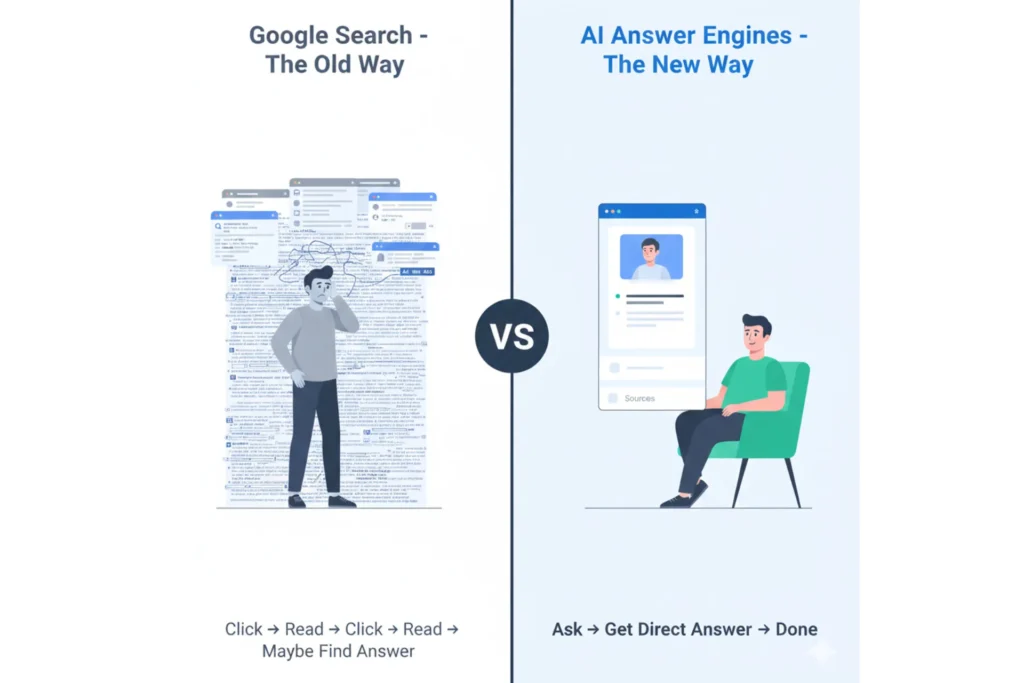
For over two decades, Google’s dominance rested on a simple, unchanging model: you ask a question, they provide you with 10 blue links. Your responsibility was to click through those links and find the answer yourself.
But starting around 2023 and accelerating dramatically through 2026, a fundamentally different model emerged and gained massive traction: the answer engine.
Google vs. Answer Engines: A Fundamental 2026 Comparison
| Aspect | Google (Traditional Search) | Answer Engines (Perplexity, ChatGPT, Claude) |
|---|---|---|
| Primary Output | List of 10 ranked links | Direct, synthesized, conversational answer |
| User Action Required | Click multiple links, read various pages, synthesize answer yourself | Read the comprehensive answer directly |
| Revenue Model | Users must click ads to generate revenue | Subscription fees, API access, minimal advertising |
| Information Source | Points to existing indexed content | Synthesizes from multiple sources with citations |
| Follow-up Capability | Requires new search query | Natural conversation continues contextually |
| Personalization | Based on search history | Based on entire conversation context |
The Librarian Analogy
Think of the difference this way:
Google is like a traditional librarian who points you toward a bookshelf and says, “Your answer is probably somewhere in those books on that shelf.” You still have to physically go there, pull out multiple books, scan through them, and find the relevant information yourself—hoping you chose the right books.
Perplexity or ChatGPT is like a brilliant research assistant who reads all the relevant books for you, synthesizes the most important points from multiple sources, and hands you a comprehensive, well-organized summary complete with footnotes showing exactly where each piece of information originated—then offers to clarify anything you don’t understand.
Why This Fundamentally Threatens Google’s Core Business
Here’s the existential threat that Google faces in 2026: Google’s entire multi-hundred-billion dollar advertising empire is built on the assumption that you will click links—specifically, the advertisements that are now virtually indistinguishable from organic results.
If AI assistants provide you with answers directly, you don’t click links. If you don’t click links, you don’t click ads. If you don’t click ads, Google doesn’t generate revenue.
This isn’t merely another competitor entering the market—it’s an entirely different business model that’s fundamentally and structurally incompatible with how Google generates money.
Perplexity AI: The Leading Answer Engine of 2026
Summary
Perplexity AI has emerged as the leading answer engine in 2026, representing a complete paradigm shift in information retrieval. Instead of providing lists of links for users to explore independently, it directly answers questions by synthesizing information from multiple sources, providing clear citations for independent verification.
By early 2026, Perplexity reportedly processes over 500 million queries monthly, with user growth accelerating as frustration with traditional search increases.
Key Features in 2026
- Direct Synthesized Answers: Provides comprehensive, well-organized responses instead of link lists
- Real-Time Source Citations: Every factual claim includes verifiable links to original sources
- Live Web Access: Accesses current web content in real-time, not limited to static training data
- Natural Follow-Up Questions: Enables genuine conversation for deeper exploration without starting over
- Multiple AI Model Options: Leverages various language models optimized for different query types
- Pro Search Deep Dive: Advanced research capability that explores topics more thoroughly
- Collections: Ability to save and organize research for ongoing projects
- Mobile Integration: Seamless cross-device experience with conversation continuity
How It Works
- User types a natural language question in conversational format
- Perplexity searches the live web in real-time using multiple sources
- AI synthesizes information from diverse sources into coherent response
- Response includes inline citations for every factual claim
- User can ask unlimited follow-up questions for clarification or deeper exploration
- System maintains context throughout entire conversation
Use Cases and Benefits in 2026
- Academic Research: Quick synthesis of complex topics with proper source attribution
- Professional Fact-Checking: Direct answers with immediately verifiable sources
- Learning & Education: Explanations tailored to user’s demonstrated knowledge level
- Business Decision Making: Balanced summaries of options, market analysis, and expert opinions
- Current Events: Real-time information synthesis from multiple news sources
- Technical Problem Solving: Step-by-step solutions with explanation of underlying concepts
- Medical Information: Preliminary health information with appropriate caveats (not replacing professional advice)
Pros and Cons (2026 Assessment)
| Pros | Cons |
|---|---|
| Saves significant time with direct, comprehensive answers | May miss highly nuanced or contested information |
| Provides clear, verifiable source citations | Dependent on underlying AI model accuracy |
| Natural conversation interface with context retention | Subscription required for full Pro features |
| Real-time web access ensures current information | Less serendipitous discovery compared to browsing |
| No advertisements cluttering the experience | May oversimplify genuinely complex, multifaceted topics |
| Respects user attention and doesn’t manipulate behavior | Potential for subtle bias inherited from training data |
| Excellent for research efficiency | Not ideal for creative exploration or brainstorming |
ChatGPT Search: OpenAI’s 2026 Challenge to Google
Summary
ChatGPT, developed by OpenAI, expanded significantly into the search market throughout 2025-2026, offering conversational search capabilities that directly compete with both traditional Google Search and specialized answer engines like Perplexity. With over 200 million weekly active users by early 2026, ChatGPT represents a massive shift in how people seek information.
Key Features in 2026
- Conversational Interface: Natural language interaction that feels like talking to a knowledgeable assistant
- GPT-4 and Beyond: Advanced reasoning capabilities that can handle complex, multi-step queries
- Web Browsing Integration: Real-time access to current information when needed
- Multi-Modal Understanding: Can analyze images, documents, and code alongside text
- Plugin Ecosystem: Extended capabilities through third-party integrations
- Memory Features: Remembers user preferences and past conversations for personalization
- Voice Interaction: Natural voice-based search and conversation on mobile devices
How It Works
- User initiates conversation with question or topic
- ChatGPT determines if web browsing is needed for current information
- Combines training knowledge with real-time search when appropriate
- Delivers conversational response with reasoning explanation
- Maintains full context for extended exploration of topics
- Can generate creative content, code, analysis, and more beyond simple answers
Pros and Cons (2026 Assessment)
| Pros | Cons |
|---|---|
| Extremely natural conversational interface | Subscription required for best models (GPT-4+) |
| Can handle creative and analytical tasks beyond search | Occasional hallucinations require verification |
| Massive user base and ecosystem | Less specialized for pure research than Perplexity |
| Regular model improvements and new features | Privacy concerns about conversation data |
| Voice and multi-modal capabilities | May generate plausible-sounding but incorrect information |
| Excellent for brainstorming and ideation | Can be slower than dedicated search for simple queries |
Google’s Desperate Response: AI Overviews in 2026
A Defensive Move, Not Innovation
When Google observed the world rapidly shifting toward direct AI-generated answers, they responded with AI Overviews—essentially attempting to bolt an answer engine onto their traditional search results infrastructure.
But this wasn’t confident, forward-thinking innovation. It was transparently a panicked, defensive reaction to an existential competitive threat that threatened their entire business model.
The Fundamental Contradiction Google Cannot Resolve
Consider Google’s impossible strategic position in 2026:
- Their business model absolutely requires users to click links (especially advertisements)
- AI Overviews give users answers directly, fundamentally reducing link clicks
- They’re literally competing with and cannibalizing themselves
- Every successful AI Overview reduces their own advertising revenue
Every time AI Overview successfully and satisfactorily answers a user’s question, that represents a user who didn’t click on advertisements. Google is being systematically forced to undermine its own revenue stream simply to remain competitive.
The Disastrous Initial Launch and Ongoing Problems
AI Overviews launched in 2024 with embarrassing, widely-publicized errors that became viral memes:
- Suggesting users put glue on pizza to help cheese stick (from a satirical Reddit post)
- Recommending eating rocks for mineral supplementation
- Providing medically dangerous health advice that could harm users
- Citing obvious jokes, satire, and parody as factual information
- Confidently stating easily verifiable false information
While Google has improved AI Overview accuracy through 2025-2026, fundamental problems persist because they reveal inherent limitations of Large Language Models (LLMs) that cannot be fully solved.
The Underlying LLM Problem
LLMs fundamentally aren’t databases of verified facts. They’re sophisticated text generators designed to produce statistically plausible-sounding sentences based on patterns in training data. They don’t actually “know” what’s true—they predict what text should come next based on probability.
This phenomenon, technically called hallucination, means LLMs can confidently state completely false information in perfectly grammatical, authoritative-sounding sentences.
Why This Fundamentally Matters for Google’s Brand:
- Google invested 25+ years systematically building a reputation for trustworthy, accurate information
- LLMs inherently produce outputs that may be unreliable, even after extensive fine-tuning
- A brand built on trust cannot simultaneously be a brand that sometimes makes things up
- Each high-profile error damages the accumulated trust capital
The Irreconcilable Paradigm Conflict:
The Original Google Model: “Truth exists out there on the web; we help you efficiently find and verify it from authoritative sources.”
The AI Overview Model: “We synthesize truth from training data and web sources, and you should trust our generated output.”
These two fundamental approaches are philosophically and practically incompatible. You cannot credibly position yourself as both the most trusted source of information AND a generator of text that sounds true but might not be accurate.
The Generational Shift: Why Gen Z and Gen Alpha Abandoned Google
Generations That Never Experienced the Magic
Perhaps the most revealing indicator of Google’s decline is how younger generations interact with information in 2026.
Gen Z (born approximately 1997-2012) grew up with an internet already saturated with advertisements and SEO-optimized spam content. They never experienced Google’s “magic era” when results felt genuinely helpful.
Gen Alpha (born 2013-2025) is the first generation growing up with AI assistants as their primary information source—many have never developed the habit of using traditional search engines at all.
Striking Statistics from 2026:
- Gen Z uses Google Search 35% less than Gen X did at the same age
- Over 50% of users under 25 don’t use Google or Maps for local business recommendations
- TikTok and Instagram are the primary “search” tools for product research, travel planning, and local discovery
- 40% of Gen Alpha’s first search experiences are with AI assistants, not traditional search engines
- Reddit has become the de facto “trust layer” added to Google searches by younger users
Google’s own executives have publicly acknowledged this trend, admitting that younger users strongly prefer visual, social, and AI-native platforms for the query types Google once dominated completely.
Why Social Search Wins for Younger Users
| Factor | Google Search | Social Search (TikTok/Instagram) |
|---|---|---|
| Format | Text links leading to articles | Short video with immediate visual proof |
| Authenticity Perception | Often perceived as SEO-optimized corporate content | Real people sharing genuine, unfiltered experiences |
| Speed to Answer | Multiple clicks, reading required | 30-60 second video contains complete information |
| Trust Signals | Anonymous websites, unclear authority | Visible creator with reputation, comments, engagement |
| Experience Preview | Reading descriptions of places/products | Actually seeing food, atmosphere, price, vibe visually |
| Engagement | Passive consumption | Interactive comments, duets, stitches |
The Distrust Generation
Gen Z and Gen Alpha grew up with distrust of traditional digital advertising fundamentally baked into their internet experience:
- They automatically assume most professionally-produced content is attempting to sell them something
- They instinctively recognize SEO-optimized articles aren’t written genuinely for their benefit
- They strongly prefer authentic human experiences over corporate marketing content
- They trust individual creators and community recommendations over institutional sources
And they consistently find that authentic, trustworthy experience on platforms Google fundamentally cannot understand, access, or index—platforms built on visual content, ephemeral sharing, and community validation.
The Fragmented Future: Where We’re Headed in 2026 and Beyond
The Death of the Universal Search Box
The era when a single white box could reliably connect you to all human knowledge is definitively ending in 2026.
Today’s information landscape is fragmenting into increasingly specialized tools optimized for different use cases:
| Information Need | Preferred Tool in 2026 | Why It Wins |
|---|---|---|
| Quick factual queries | AI answer engines (Perplexity, ChatGPT, Claude) | Direct answers, no clicking required |
| Recommendations and cultural trends | Social search (TikTok, Instagram) | Visual proof, authentic human perspectives |
| Deep niche knowledge | Community forums (Reddit, Discord) | Expert communities, genuine discussion |
| Professional research | Specialized databases and AI research tools | Domain-specific accuracy and depth |
| Local services and businesses | Vertical search apps (Yelp, Google Maps, specialized apps) | Reviews, real-time information |
| Shopping and product research | Amazon, TikTok Shop, social commerce | Reviews, visual demos, one-click purchase |
| News and current events | Aggregators, newsletters, social feeds | Personalization, multiple perspectives |
Implications for Content Creators in 2026
This platform fragmentation creates serious, potentially existential problems for people who create online content:
Writers, Journalists, Artists, Educators, and Subject Matter Experts:
- Their livelihoods traditionally depended heavily on Google traffic
- AI can now summarize their original work without sending any visitors to their sites
- No clicks means no advertising revenue, no subscription conversions, no sustainable income
- The economic model that supported quality independent content creation is fundamentally collapsing
- Many are pivoting to platforms like Substack, Patreon, and YouTube for direct audience relationships
The Open Web Question:
For decades, people invested enormous effort creating public, high-quality websites hoping to rank well on Google and reach global audiences. But if traffic increasingly flows to AI summaries that don’t credit sources and walled garden platforms Google can’t index, what’s the rational incentive to create publicly accessible content?
The original dream of an open web—freely accessible information contributed by millions of independent creators—may be fading as the economic foundation that supported it crumbles.
Comprehensive Comparison: Search Platforms in 2026
| Feature | Google Search | Perplexity AI | ChatGPT | TikTok/Social | |
|---|---|---|---|---|---|
| Primary Output | Ranked link list | Synthesized answers | Conversational responses | Visual content | Community discussions |
| Revenue Model | Advertising | Subscription + API | Subscription + API | Advertising + commerce | Advertising + Premium |
| Trust Signal | PageRank (degraded) | AI + source citations | AI reasoning | Creator reputation | Community upvotes |
| Content Format | Text-based websites | Text summaries | Conversational text | Short-form video | Threaded discussions |
| Best For | Comprehensive site lists | Research and facts | Complex questions | Visual recommendations | Niche expertise |
| Biggest Weakness | Ad saturation, SEO spam | Subscription cost | Hallucinations | Filter bubbles | Quality variation |
| 2026 Trend | Declining | Strong growth | Strong growth | Strong growth | Moderate growth |
Frequently Asked Questions (FAQ)
1. Is Google Search actually dying in 2026, or is this exaggeration?
Google Search isn’t dying in the sense that the service will completely disappear—it still processes billions of queries daily and remains the world’s most-used search engine by total volume. However, it’s experiencing significant, measurable decline in user trust, perceived relevance, and usage share—particularly among users under 35. The product that exists in 2026 bears little resemblance to the revolutionary tool that launched in the late 1990s. Between advertising saturation, AI-generated content spam, and vigorous competition from AI answer engines and social platforms, Google Search has lost the dominant, trusted position it once held. Many analysts now describe it as a declining platform rather than a growing one.
2. What is enshittification and how does it specifically apply to Google in 2026?
Enshittification is a term coined by digital rights activist Cory Doctorow describing the predictable decay pattern of digital platforms that achieve market dominance. The process follows three distinct stages: first, platforms attract users by providing genuinely exceptional service, often operating at a loss; second, they begin exploiting those locked-in users to benefit business customers (primarily advertisers); third, they exploit business customers as well to maximize returns for shareholders. Google has progressed through all three stages by 2026—from a genuinely user-first tool in its early years to an ad-dominated platform that increasingly serves neither users nor advertisers as effectively as it once did, while extracting maximum revenue from both groups.
3. Why do millions of people add “Reddit” to their Google searches in 2026?
Users add “Reddit” to their search queries because they specifically want authentic human responses rather than SEO-optimized content or AI-generated text. Reddit discussions typically feature real people sharing genuine experiences, honest opinions, and practical solutions. By appending “Reddit” to queries, users essentially instruct Google’s algorithm: “Filter out the marketing content, the AI garbage, and the SEO-optimized articles—show me only content written by actual humans sharing real experiences.” This workaround has become so common that it represents a significant portion of Google’s total search volume, essentially using Reddit as a trust filter for Google’s degraded results.
4. Are AI answer engines like Perplexity actually better than Google in 2026?
For many common use cases, yes—AI answer engines demonstrably outperform Google Search in 2026. They excel at synthesizing information from multiple sources, providing direct comprehensive answers to factual queries, and saving significant time by eliminating the need to click through numerous links and mentally synthesize information yourself. However, they have meaningful limitations, including the persistent potential for hallucinations (confidently stating false information), less serendipitous discovery of related content, and reduced exposure to diverse perspectives. The optimal approach in 2026 may be strategically using different tools for different information needs—AI for quick facts, social platforms for recommendations, and specialized communities for deep expertise.
5. What is Google’s AI Overview and why has it been controversial?
AI Overview is Google’s defensive attempt to compete with AI answer engines by providing synthesized answers directly within search results. It launched in 2024 and has been highly controversial for multiple reasons: it frequently contained embarrassing factual errors at launch (including dangerous health misinformation), it fundamentally reduces traffic to content creators whose work is being summarized without compensation, and it directly conflicts with Google’s core advertising-based business model that depends on link clicks. Many industry observers view it as a desperate, reactive move rather than genuine innovation—Google was forced to cannibalize its own revenue model simply to avoid appearing obsolete compared to competitors like Perplexity and ChatGPT.
6. How are Gen Z and Gen Alpha fundamentally changing the search landscape in 2026?
Gen Z uses Google Search significantly less than older generations, strongly preferring visual platforms like TikTok and Instagram for many query types. Gen Alpha, meanwhile, is the first generation growing up with AI assistants as their primary information interface—many have never developed traditional search engine habits at all. These younger generations grew up with ad-saturated, SEO-gamed, spam-filled search results, so they never experienced Google’s genuinely magical early era. They instinctively trust authentic human content from visible creators over anonymous institutional articles, and they consistently find that authenticity on social platforms and AI assistants rather than traditional search engines. This generational shift may permanently reshape information seeking behavior.
7. What happened to Google’s famous “Don’t Be Evil” motto?
Google quietly removed “Don’t Be Evil” from its official code of conduct in 2018, replacing it with the more corporate-sounding “Do the right thing.” The original motto represented a genuine commitment to user-first principles, ethical practices, and maintaining a clear separation between organic content and advertising. However, as the company increasingly prioritized advertising revenue, shareholder returns, and market dominance, the widening gap between the motto and everyday reality became increasingly difficult to maintain credibly. The removal was widely interpreted as a tacit acknowledgment that commercial interests had definitively triumphed over the idealistic founding philosophy.
8. Can Google realistically recover its position as the dominant, trusted search platform?
Meaningful recovery would require fundamental changes that would significantly hurt short-term revenue: dramatically reducing ad prominence and visual manipulation, cracking down much harder on SEO spam and AI-generated garbage content, solving the inherent AI hallucination problem, and rebuilding the trust systematically eroded over 15+ years. Given relentless Wall Street pressure for quarterly growth and the deeply structural nature of the challenges Google faces, significant recovery seems unlikely. More probable is continued fragmentation of the search market, with different specialized tools serving different information needs—and Google retaining significant but diminished market share as a general-purpose option for users who haven’t yet adopted alternatives.
9. What does this transformation mean for website owners and content creators in 2026?
The implications are significant and mostly challenging for traditional content creators. Traffic from Google is declining in both quantity and quality, and the traffic that does arrive is becoming less valuable for conversion. Content creators must increasingly diversify their presence across multiple platforms—building audiences on social media, growing email newsletters, participating in relevant communities—rather than depending primarily on Google Search traffic. Building direct, owned relationships with audiences through email lists, paid communities, and platform-independent channels is increasingly critical as algorithmic distribution becomes less reliable and less lucrative. Many successful creators in 2026 treat Google traffic as a nice bonus rather than a foundation.
10. What will search and information discovery look like in 2030?
The most likely scenario is continued fragmentation rather than any single dominant platform replacing Google. We’ll probably see AI assistants (increasingly integrated into devices and operating systems) handling the majority of factual queries and task completion. Social platforms will continue dominating recommendations, trend discovery, and cultural information. Specialized niche communities will serve deep expertise needs in specific domains. Traditional search engines will serve a diminished but still meaningful role for certain query types—particularly comprehensive research and finding specific websites. The era of “one tool to find everything” appears to be definitively ending, replaced by a more complex but potentially more specialized and effective information ecosystem. Whether this fragmented future is better or worse for users and creators remains an open question.
Conclusion
The death of Google Search in 2026 represents far more than the decline of a single technology product—it marks the definitive end of an era when a simple white box could reliably connect you to all human knowledge.
Google’s journey from revolutionary, user-first tool to enshittified, ad-dominated platform followed a depressingly predictable pattern: attract users with genuinely exceptional service, exploit those locked-in users to serve advertisers, then exploit everyone to maximize shareholder returns. Along the way, the trust that made Google valuable was systematically monetized and sold off for short-term revenue.
In 2026, we’re firmly established in a new, more fragmented information age. AI answer engines like Perplexity and ChatGPT handle direct questions with remarkable efficiency. Social search platforms like TikTok dominate visual discovery and recommendations. Niche communities like Reddit and Discord serve specialized knowledge needs with authentic human expertise. Each tool serves different needs better than Google can.
The open web dream is fading as valuable content increasingly moves into walled gardens Google cannot access and AI summaries that don’t compensate creators. The economic model that supported independent quality content creation is under severe stress.
Whether this fragmented future is ultimately better or worse than Google’s unified dominance remains to be seen. It may prove more human-centered, or more artificial. More diverse, or more divided. More efficient, or more chaotic.
But one thing is absolutely certain: it’s not the Google we once knew.
The question now isn’t whether Google Search will survive in some form—it almost certainly will. The question is what will replace the unified, trusted information landscape it once represented, and whether the alternatives will serve humanity’s knowledge needs as well as early Google once did.
What’s your experience with search in 2026? Have you shifted to AI assistants, social platforms, or niche communities? Share your perspective in the comments below.