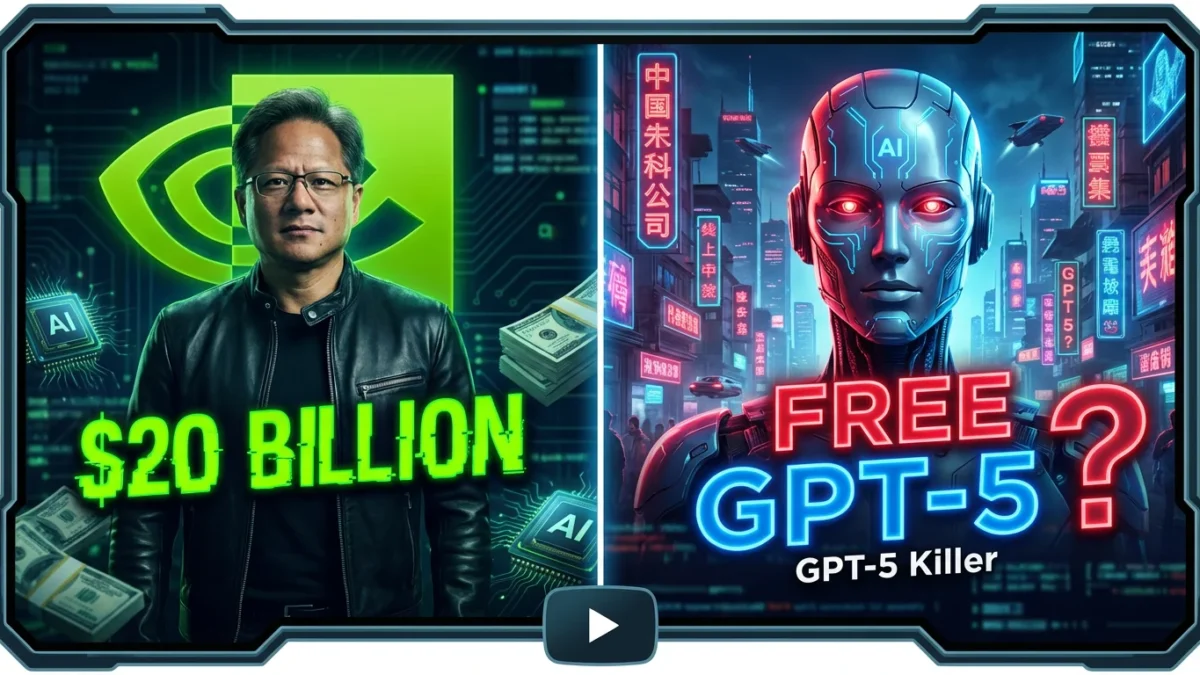
The Ultimate AI News Roundup: Nvidia’s $20 Billion Power Move, China’s Free AI Revolution, and the Future of Warfare
From Nvidia’s largest acquisition ever to military headsets with X-ray vision, this week’s AI developments are reshaping the technology landscape at an unprecedented pace.
Nvidia’s Historic $20 Billion Groq Acquisition: A Strategic Masterstroke
The largest deal in Nvidia’s history isn’t just about buying a competitor—it’s about owning the entire AI chip ecosystem.
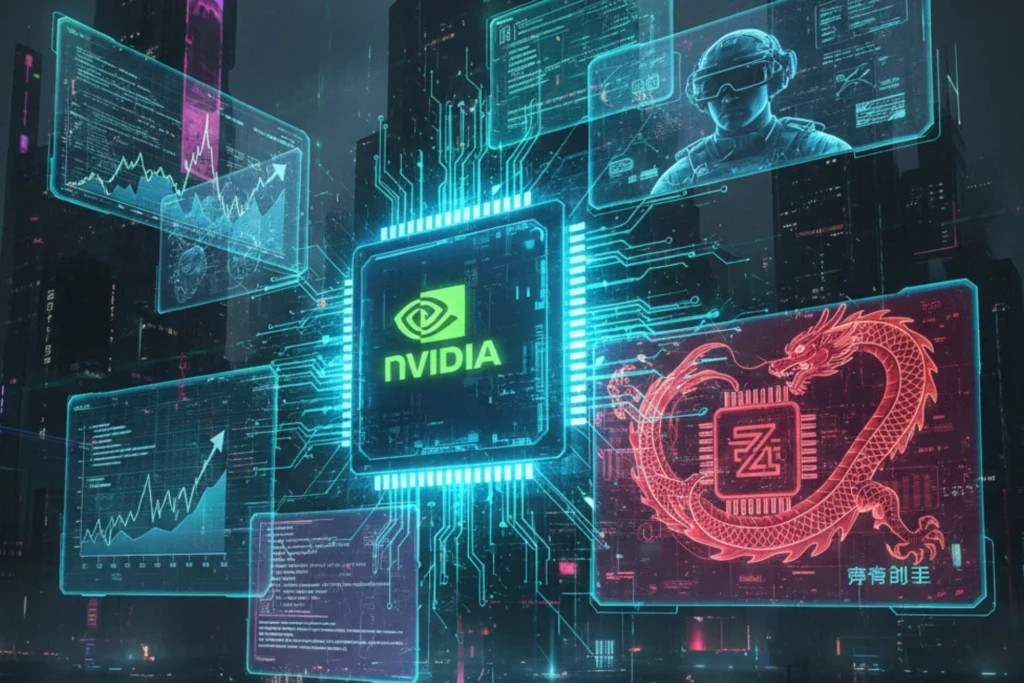
Nvidia has officially acquired Groq for a staggering $20 billion, marking the company’s most significant acquisition to date. What makes this deal even more remarkable? Groq’s valuation has tripled in just three months, signaling the incredible value Nvidia sees in this strategic purchase.
Who is Groq and Why Does This Matter?
Jonathan Ross, Groq’s founder, is the brilliant engineer who built Google’s Tensor Processing Unit (TPU)—the chip that powers over half of Google’s AI infrastructure. His work essentially proved to the entire technology industry that Nvidia isn’t the only path forward for AI computing.
After leaving Google, Ross founded Groq with a laser focus on inference computing rather than training—a strategic distinction that makes all the difference.
Understanding Training vs. Inference
| Aspect | Training | Inference |
|---|---|---|
| Definition | Teaching AI models (one-time process) | AI responding to user prompts |
| Frequency | Once per model | Every single interaction |
| Cost Structure | One-time investment | Continuous operational cost |
| Scale Impact | Limited scalability concerns | Massive scalability requirements |
Groq developed chips that run inference 10 times faster while consuming one-tenth the energy of traditional solutions. At scale, this efficiency makes Groq’s technology irresistible to every major cloud provider worldwide.
Nvidia’s Monopolistic Chess Move
With Google’s TPUs already challenging Nvidia’s dominance, Groq represented the next emerging threat. Jensen Huang’s solution? Simply acquire the competition.
Now Nvidia controls:
- GPUs for AI training (the established standard)
- LPUs for AI inference (the emerging standard)
This acquisition exemplifies the classic Silicon Valley playbook: when you can’t beat the competition, buy them. Nvidia now owns both the problem and the solution in the AI chip market.
China’s Free AI Models Are Beating Google, Anthropic, and OpenAI
Two groundbreaking Chinese AI models dropped this week, both free and open-source—and they’re outperforming the most expensive paid alternatives.

Zhipu AI’s GLM 4.7: A New Coding Champion
Zhipu AI has released GLM 4.7, currently ranking #6 on the global WebDev leaderboard. The model sits just behind Gemini 3 Pro and has already surpassed GPT-5 in key benchmarks.
What Makes GLM 4.7 Different?
- Completely free to download with full model weights publicly available
- No API costs—run it on your own hardware
- 73.8% on real coding benchmarks—matching Claude 4.5’s performance
- Seamless integration with tools like Claude Code and Cline
Real-World Testing: Stock Ticker Dashboard
To verify the hype, we tested GLM 4.7 with a complex prompt: building a real-time stock ticker dashboard in a single HTML file with:
- Dark theme with neon accents
- Fake stock symbols updating every two seconds
- Sparkline mini-charts
- Pure vanilla JavaScript (no external libraries)
The result? GLM 4.7 nailed it on the first try—real-time updates, perfect UI, and working sparklines. This is exactly the type of complex, multi-component web build that the WebDev arena evaluates.
MiniMax M2.1: The Multi-Language Coding Powerhouse
While most AI models excel primarily at Python, MiniMax M2.1 handles the full spectrum of programming languages that development teams actually use daily:
- JavaScript
- Swift
- Kotlin
- Rust
- Go
- And many more
Key Advantages of M2.1:
| Feature | Benefit |
|---|---|
| Production-Quality Output | Clean UI, smooth animations—looks like finished products |
| Cost Efficiency | Fraction of Claude’s cost |
| Speed | Nearly twice as fast as comparable models |
| Open Source | Download and run yourself—no fees, no limits |
Developers are reporting that M2.1 “feels like Claude, but at a fraction of the cost.”
YouTube Transforms Into a Game Engine
YouTube Gaming’s Playables Builder, powered by Gemini 3, lets creators build actual playable games using only text prompts—no coding required.
How It Works
- Describe your game idea in natural language
- Gemini builds it automatically
- Your audience plays directly inside YouTube
Early Creator Success Stories
| Creator | Game Created |
|---|---|
| Sambucha | Booker Blocks |
| I Christine | Sugar Cube |
| Gohar’s Guide | Study Zone |
The Bigger Picture
This development signals a fundamental shift in content creation. YouTube is evolving from a passive watching platform into an interactive experience hub where:
- Viewers don’t just watch—they play
- Gaming channels feature games their creators built
- Content becomes a two-way interactive experience
The beta is now open for creators in select markets. This could revolutionize how gaming content creators engage with their audiences.
Nvidia Vision: Democratizing Video Production
What used to cost tens of thousands of dollars and take weeks now takes seconds—and it’s completely free.
Nvidia has launched Vision, a revolutionary tool featuring four powerful capabilities for video production professionals:
The Four Pillars of Nvidia Vision
1. Boards
Generate a complete 3×3 storyboard with nine different shots from a single prompt. Perfect for pre-visualizing entire scenes before shooting.
2. Looks
Create multiple visual styles from the same concept:
- Cinematic
- Anime
- Noir
- Fantasy
- And more
Same scene, different aesthetics—ideal for finding the exact vibe you’re imagining.
3. Angles
Access every camera perspective instantly:
- Low angle
- High angle
- Close-up
- Wide shot
It’s like having a professional cinematographer plan your coverage in seconds.
4. Extract Shot
Pull any single frame from your storyboard to:
- Refine details
- Expand the concept
- Animate further
- Create final assets
Vision is currently completely free on Nvidia’s platform—an incredible opportunity for creators and production teams.
OpenAI Codex Skills: Saved Instructions That Transform Workflow
Set up your coding preferences once, and Codex remembers exactly how you want things done—forever.
OpenAI has introduced Skills to Codex, fundamentally changing how development teams maintain consistency across projects.
What Are Skills?
Skills are saved instructions that Codex retains and applies automatically. Configure them once, and your preferences persist across all future interactions.
Practical Applications
| Use Case | Benefit |
|---|---|
| Code documentation format | Consistent commenting style across all files |
| Team review checklists | Standardized quality assurance |
| Naming conventions | Unified variable and function names |
| Architecture patterns | Consistent code structure |
How to Use Skills
Using Skills is straightforward:
- Type $ followed by the skill name
- Or describe what you need in natural language
- Codex identifies and applies the appropriate skill
Team Collaboration Benefits
When your entire team shares the same Skills:
- Code stays consistent across all contributors
- No more back-and-forth on style preferences
- The agent understands how your team operates
Skills are now live in Codex CLI and the IDE extension.
Alibaba Drops Two Open-Source AI Models in One Week
Both models are completely free—and they’re solving problems other tools consistently fail at.
Qwen Image Edit 2511: Character-Consistent Image Editing
This image editing model addresses the persistent challenge of maintaining consistency across edits:
Key Features:
- Character consistency in group photos—every face stays accurate
- Built-in lighting controls for professional results
- Camera angle switching without losing quality
- Material swapping for product design (carbon fiber to resin to gold)
Practical Applications:
| Industry | Use Case |
|---|---|
| E-commerce | Batch editing product shots |
| Marketing | Consistent brand imagery |
| Product Design | Material visualization |
| Photography | Multi-image consistency |
Where competitors like Craiyon and NanoBanana fail—particularly with face and text consistency across multiple images—Qwen Image Edit 2511 excels.
Fun Audio Chat: Voice AI That Understands Emotions
This isn’t just another voice AI—it actually comprehends emotions.
Emotional Intelligence in Action:
The model picks up on your tone and mood, not just your words:
- Whisper that you’re scared walking home alone → responds gently, offers to stay on the line
- Same sentence in a happy vs. sad voice → completely different, appropriate responses
Technical Advantages:
| Specification | Benefit |
|---|---|
| 5 FPS (vs. industry standard 25 FPS) | 50% reduction in GPU costs |
| Top ranking on OpenAudioBench | Best-in-class spoken question handling |
| 8B model architecture | Efficient resource utilization |
Integration Possibilities:
- Voice assistants
- Customer service bots
- Function calls (booking, navigation, commands)
- Interactive applications
Both models are available now on Hugging Face and Model Scope.
Nvidia Nitrogen: AI That Learned Gaming From YouTube and Twitch
Nvidia built an AI that taught itself over 1,000 video games by watching streamers—and they’re giving it away for free.
The Ingenious Training Method
Nvidia’s approach was brilliantly simple: they only used videos where streamers had controller overlays on screen. This allowed the AI to literally watch what buttons players pressed and learn from their actions.
Result: Millions of hours of streaming content transformed into the world’s largest gaming tutorial.
Nitrogen’s Capabilities
A single AI model now plays:
- RPGs
- Battle royales
- 3D action games
- 2D sidescrollers
- Games it has never encountered before
Why This Matters Beyond Gaming
Here’s the critical insight: Nitrogen runs on the same neural architecture Nvidia uses for robotics.
Every skill this AI develops in gaming—reflexes, timing, situational awareness—can potentially transfer to physical machines in the real world.
| Gaming Skill | Robotics Application |
|---|---|
| Quick reflexes | Real-time response systems |
| Timing optimization | Precision manufacturing |
| Environmental awareness | Navigation and obstacle avoidance |
| Adaptive learning | Novel situation handling |
Nvidia proved you can train a robot’s brain using Twitch streams.
Open-Source Release
Nvidia is releasing everything:
- Complete dataset
- Model weights
- Source code
We’ve evolved from AIs that master one game to an AI that learns how to play any game. Gaming is the proof of concept; robotics is the endgame.
Windsurf’s Free Coding AI: Parallel Agents Change Everything
SWE 1.5 is free for three months—and it offers capabilities neither Cursor nor Copilot can match.
Windsurf has released their flagship coding model, SWE 1.5, for free, positioning it as a serious competitor to established players.
Benchmark Performance
SWE 1.5 ranks just behind Claude on coding benchmarks while being offered at zero cost for the promotional period.
The Game-Changer: Parallel AI Agents
The revolutionary feature? Multiple AI agents running simultaneously:
| Agent 1 | Agent 2 | Agent 3 |
|---|---|---|
| Fixing bugs | Building new features | Writing tests |
No more waiting for one task to complete before starting the next. Watch all agents work side-by-side like a command center for code.
Competitive Advantage
| Feature | Windsurf | Cursor | Copilot |
|---|---|---|---|
| Parallel agents | ✅ | ❌ | ❌ |
| Free tier | ✅ (3 months) | Limited | Limited |
| Terminal reliability | ✅ (fixed) | Variable | Variable |
The terminal command issue that plagued many coding AI tools? Windsurf fixed it.
Anduril’s Eagle-Eye: Military Headset With X-Ray Vision
Palmer Luckey, the creator of Oculus VR, just demoed technology that looks straight out of a video game—but it’s very real.
The founder who sold Oculus to Facebook for $2 billion recently demonstrated Anduril’s new military headset, Eagle-Eye, on Japanese television.
Eagle-Eye’s Capabilities
| Feature | Description |
|---|---|
| X-Ray Vision | See enemies through walls and buildings |
| Real-Time Translation | Instant language processing |
| Enemy Tracking | Persistent threat awareness |
| Shared Awareness | What one soldier sees, all soldiers see |
How It Works
When one soldier wearing Eagle-Eye spots an enemy, every other soldier wearing the system sees them too—even if they’re:
- In a completely different room
- Behind a wall
- Around the corner
If a drone overhead spots enemies hiding behind buildings, that intelligence projects directly into every connected headset.
The Technical Marvel
Here’s the remarkable engineering detail: the entire system runs on a bulletproof plate.
The same armor plate that stops bullets serves as the computer running all the AI. Protection and intelligence in a single integrated unit.
Future Implications
This technology represents what combat will look like within a few years—shared situational awareness, augmented reality overlays, and AI-powered threat detection working in real-time.
Top 10 Coolest AI Tools That Launched This Week
The most innovative and underrated tools you need to know about:
1. Reducto
Transforms messy documents into clean AI-ready data. Drop in contracts, invoices, even handwritten notes—Reducto extracts the information you need automatically.
2. Agent S2 (Simular AI)
Open-source agent that controls your computer autonomously. Tell it to edit spreadsheets or resize images, and it navigates through the steps like a human operator.
3. Noise AI
Clone any voice from just 3 seconds of audio. Record yourself once, then generate voiceovers in your voice for videos, podcasts, and any content.
4. Loki Build
Create landing pages using AI. Describe your product in natural language, and Loki generates a polished, professional website in seconds.
5. Many API
Turn any website into an API. Point it at any page, define the data you need, and receive structured information ready for use anywhere.
6. Agen.cy
Build automations by describing what you want. No drag-and-drop interfaces, no code—just describe your workflow in plain English.
7. Firecrawl (New Agent Endpoint)
AI-powered web research that goes where others can’t. Give it a prompt, and it searches the web, clicks through pages, and gathers information from sites other scrapers can’t access.
8. ClickUp Super Agents
AI teammates living inside ClickUp. Assign tasks, tag in comments, and these agents handle drafting emails, scheduling meetings, and more.
9. Enbot
Build AI curators that track any topic across the web. Describe your interests, and Enbot scans news, blogs, and social media—even converting your feed into a daily podcast.
10. Typeless
AI voice dictation that actually works. Speak naturally with all the “ums” and pauses—Typeless outputs clean, polished text at 4x typing speed across every application.
Key Takeaways: What This Week’s AI Developments Mean
This week’s developments highlight several critical trends shaping the AI landscape:
The Consolidation of Power
Nvidia’s $20 billion Groq acquisition demonstrates how major players are moving to own entire ecosystems rather than compete within them.
The Democratization of AI
China’s free, open-source models matching or beating paid alternatives signals a potential shift in how AI technology will be accessed and deployed globally.
The Blurring of Reality and Fiction
From X-ray vision for soldiers to AI that learns from Twitch streams, the line between science fiction and reality continues to fade.
The Developer Tool Revolution
Parallel agents, saved Skills, and improved coding models are fundamentally changing how software gets built.
Frequently Asked Questions
What is the significance of Nvidia acquiring Groq?
Nvidia’s $20 billion acquisition of Groq represents a strategic move to control both AI training (GPUs) and AI inference (LPUs) markets. By acquiring the company founded by the creator of Google’s TPU, Nvidia eliminates a potential competitor while expanding its technological portfolio.
Are Chinese AI models really free?
Yes, both GLM 4.7 from Zhipu AI and M2.1 from MiniMax are completely free and open-source. You can download the full model weights and run them on your own hardware without API costs or usage limits.
How does Nvidia Vision differ from other AI video tools?
Nvidia Vision offers four integrated capabilities (Boards, Looks, Angles, Extract Shot) that work together for comprehensive pre-production planning. It’s currently free and can accomplish in seconds what traditionally required weeks and tens of thousands of dollars.
What makes Eagle-Eye different from consumer AR headsets?
Eagle-Eye is specifically designed for military applications, featuring shared situational awareness across units, real-time translation, and enemy tracking capabilities. The entire system runs on integrated bulletproof armor.
Can Windsurf’s parallel agents really replace multiple developers?
While parallel agents can handle multiple coding tasks simultaneously, they’re designed to augment developer productivity rather than replace human engineers. They excel at routine tasks like bug fixing, feature building, and test writing.
Conclusion: The Pace of Change Is Only Accelerating
This week delivered a concentration of AI developments that would have seemed impossible just a year ago:
- A $20 billion acquisition reshaping the chip industry
- Two free AI models outperforming billion-dollar competitors
- Military technology with science fiction capabilities
- Creative tools democratizing video production
As 2025 progresses, we’re witnessing the transformation of AI from a specialized technology into the fundamental infrastructure of modern business, creativity, and even warfare.
The organizations and individuals who understand these developments—and act on them—will have significant advantages in the months and years ahead.
What development surprised you most this week? Share your thoughts in the comments below.
Subscribe for weekly AI updates delivered straight to your inbox.
Related Reading:
- Complete Guide to Open-Source AI Models in 2025
- Understanding AI Chips: GPUs, TPUs, and LPUs Explained
- The Future of AI-Powered Creative Tools