GPT Image 1.5 vs Nano Banana Pro: Complete AI Image Generator Comparison Guide for 2025
GPT Image 1.5 vs Nano Banana Pro - The Ultimate AI Image Generator Battle of 2025
Introduction
GPT Image 1.5 vs Nano Banana Pro has become the most searched comparison in the AI image generation space, and for good reason. If you're a content creator, marketer, student, or just someone curious about which AI tool actually delivers better results, this comprehensive guide is exactly what you need.
The AI image generation landscape has exploded in recent months. OpenAI's Ghibli-style image feature brought millions of new users, and now both OpenAI and Google are pushing their latest models harder than ever. But marketing claims don't tell the full story. What matters is real-world performance across different use cases.
In this article, you'll discover detailed test results across 10 different scenarios, from movie posters to medical diagrams, multilingual text to progressive edits. By the end, you'll know exactly which tool suits your specific needs and why.
What's New in GPT Image 1.5
OpenAI has been moving fast in the AI image generation space. Following the massive success of their Ghibli-style feature (which reportedly brought in a million new users within an hour), they've now released GPT Image 1.5 with significant improvements.
Key Features of GPT Image 1.5
- Four times faster generation speed compared to previous versions
- Improved text rendering with better spelling accuracy
- Enhanced facial generation for more realistic human portraits
- Dedicated Images Tab in the ChatGPT sidebar for easier access
- Predefined style templates including Bollywood poster, festival vibes, Navratri themes, Jaipur textile patterns, landscape sketches, and doodle styles
- "Discover Something New" section for creative inspiration and guided workflows
How GPT Image 1.5 Works
- Navigate to the Images tab in ChatGPT's left sidebar
- Enter your prompt in the standard description area
- Optionally select from predefined styles in the "Try a Style" section
- Generate your image with a single click
- Iterate and refine using follow-up prompts
Use Cases for GPT Image 1.5
- Marketing materials and social media content
- Educational diagrams and infographics
- Product mockups and concept visualization
- Birthday cards and personalized graphics
- Brand asset creation
Pros and Cons of GPT Image 1.5
| Pros | Cons |
|---|---|
| User-friendly interface with templates | Inconsistent with non-English text |
| Fast generation speed | Facial consistency issues in edits |
| Good English text accuracy | Cultural context sometimes missed |
| Integrated with ChatGPT ecosystem | No specific output resolution control |
| Helpful for beginners | Can miss complex prompt details |
Understanding Nano Banana Pro
Google's Nano Banana Pro, powered by the Gemini 3 architecture, takes a different approach to AI image generation. While it lacks the guided templates of GPT Image 1.5, it compensates with raw power and contextual understanding.
Key Features of Nano Banana Pro
- Gemini 3 brain for enhanced contextual understanding
- 4K output resolution for professional-quality images
- Strong multilingual support including Hindi, Japanese, and other scripts
- Superior cultural context recognition
- Clean, minimal interface focused on prompt engineering
How Nano Banana Pro Works
- Access the Nano Banana Pro interface
- Enter your detailed prompt in the text box
- The AI processes your request using Gemini 3 architecture
- Receive high-resolution output, often in 4K quality
- Refine with additional prompts as needed
Use Cases for Nano Banana Pro
- Professional marketing campaigns requiring cultural accuracy
- Multilingual content for global audiences
- High-resolution prints and displays
- Complex creative projects requiring contextual understanding
- UI/UX mockups and design work
Pros and Cons of Nano Banana Pro
| Pros | Cons |
|---|---|
| Excellent cultural context understanding | No predefined templates or styles |
| 4K output resolution | Steeper learning curve for beginners |
| Strong multilingual text accuracy | Requires prompt engineering skills |
| Superior franchise/brand recognition | Minimal user interface |
| Professional-grade output quality | Less beginner-friendly |
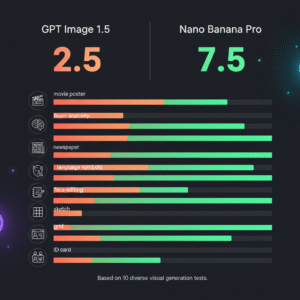
Feature Comparison: GPT Image 1.5 Interface vs Nano Banana Pro Capabilities
Test 1: Movie Poster Creation
The first test in our GPT Image 1.5 vs Nano Banana Pro comparison focuses on creating a cinematic movie poster for "Avatar: Fire and Ash," scheduled for release on December 19, 2025.
The Challenge
Create a cinematic Avatar poster featuring:
- Title at the top
- "Fire and Ash" aesthetic with dramatic elements
- Na'vi text reading "A1 Yahoo"
- Release date prominently displayed
- Theater-quality composition
GPT Image 1.5 Results
The output from GPT Image 1.5 displayed impressive visual qualities:
- Colors: Dramatic and cinematic
- Fire elements: Present and well-rendered
- Text accuracy: Title spelled correctly as "Avatar: Fire and Ash"
- Layout: Professional poster composition
However, there was a significant issue. The Na'vi characters depicted in the poster were completely invented. They didn't resemble any characters from the Avatar franchise. GPT essentially created "pretty aliens" rather than authentic Avatar characters.
Nano Banana Pro Results
Nano Banana Pro took a different approach:
- Style: More animated, stylized aesthetic
- Character accuracy: Characters actually resembled the Avatar universe
- Design language: Matched the franchise's established visual identity
- Facial structures: Consistent with known Avatar characters
Winner: Nano Banana Pro
Superior contextual understanding of the Avatar franchise
While GPT Image 1.5 followed the technical prompt requirements better (text, layout, composition), Nano Banana Pro demonstrated superior contextual understanding. For a movie poster, using invented characters that don't match the franchise is a critical failure. The Gemini 3 brain powering Nano Banana Pro understood what Avatar actually looks like, making it the clear winner for this test.
Test 2: Educational Brain Anatomy Diagram
This test carries significant real-world implications. Students increasingly use AI to create study materials, diagrams, and flashcards. But what happens if the labels are wrong? A mislabeled thalamus could mean a failed exam—or worse, medical errors down the line.
The Challenge
Create a detailed brain diagram featuring:
- Sagittal and coronal views
- Color-coded lobes
- Properly labeled structures including corpus callosum, thalamus, hypothalamus, and brain stem
- Educational accuracy suitable for study materials
GPT Image 1.5 Results
GPT Image 1.5 delivered a textbook-style diagram:
- Style: Clean layout with clear hierarchy
- Facial profile: Included for anatomical orientation
- Labels: Corpus callosum, thalamus, hypothalamus, pituitary, and brain stem all pointing to correct locations
- Accuracy: Anatomically correct
Nano Banana Pro Results
Nano Banana Pro produced a modern 3D render:
- Style: Clean, contemporary aesthetic
- Labels: Frontal, parietal, corpus callosum, thalamus, hypothalamus, brain stem—all correct
- Presentation: Visually striking but lacking anatomical context
Winner: GPT Image 1.5
Better educational presentation with anatomical context
Both models achieved anatomical accuracy, which is the most critical factor. A student could safely use either diagram without learning incorrect information. However, for educational purposes, GPT's textbook style with facial profile provides better spatial context. The visual hierarchy and traditional presentation make it more functional as an actual study tool.
Test 3: Dense Text Rendering
Text generation has historically been AI image generation's biggest weakness. Spelling errors, gibberish characters, and weird letter spacing have plagued even the best models. OpenAI claims GPT Image 1.5 handles dense text better than ever. This test puts that claim to the test.
The Challenge
Create a 1920s newspaper front page featuring:
- Specific headlines with multiple columns
- Dense body text throughout
- A political cartoon with caption
- Period-appropriate typography and layout
GPT Image 1.5 Results
The output impressed with its attention to detail:
- Masthead: "The Daily Gazette" rendered correctly
- Headlines: Main and sub-headlines spelled accurately
- Cartoon: Present with proper caption
- Layout: Balanced, not text-heavy
- Text quality: No gibberish or artifacts
Nano Banana Pro Results
Nano Banana Pro delivered a distinctly different aesthetic:
- Masthead: "The Daily Chronicle" with authentic aging
- Visual texture: Darker, aged appearance resembling actual vintage newspapers
- Headlines: Correctly spelled
- Cartoon: Present and properly integrated
- Density: More text-heavy, matching authentic newspaper layouts
Winner: Tie
Both models delivered excellent text accuracy
Both models successfully handled dense text generation—a notable achievement given historical AI limitations in this area. Headlines were spelled correctly, no artifacts appeared, and both followed the prompt accurately. The only difference was artistic interpretation: GPT went clean and balanced while Nano went authentic and dense. Since both approaches are valid, this test ends in a draw.
Test 4: Multilingual Text Handling
English text is one thing, but what about Devanagari script? Hindi text with complex conjunctions? Non-English text has always challenged image generation models. This test examines whether that's changed.
The Challenge
Create a 1960s-70s retro Coca-Cola poster featuring:
- Hindi text in Devanagari script
- Japanese vintage aesthetic
- Proper bilingual balance
- Cultural authenticity for both represented cultures
GPT Image 1.5 Results
The output showed mixed results:
- Hindi text: "Coca-Cola" rendered correctly in Devanagari
- Script quality: Properly formed characters
- Branding: Red and white theme present with taglines
- Japanese elements: Mount Fuji, rising sun, vending machines included
- Model: Appeared Indian rather than Japanese
Nano Banana Pro Results
Nano Banana Pro delivered stronger cultural coherence:
- Hindi text: Correctly rendered Devanagari script
- Japanese elements: Mount Fuji, cherry blossoms, classic Coke bottle
- Overall aesthetic: Full Japanese vintage style achieved
- Cultural integration: Cohesive blend of all requested elements
Winner: Nano Banana Pro
Superior cultural context and bilingual accuracy
Both models impressively handled Hindi text accurately—a significant improvement over previous AI generations. However, the prompt specifically requested a Japanese vintage aesthetic. While GPT included Japanese background elements, it placed an Indian-looking model in what should be a Japanese-style advertisement. That's a fundamental cultural mismatch. Nano understood the assignment and delivered authentic cultural fusion.
Test 5: Progressive Facial Edits
When Sam Altman announced GPT Image 1.5, he specifically highlighted facial consistency as a key improvement. This test stress-tests that claim with five consecutive edits on a single image.
The Challenge
Starting with a reference image, apply five sequential edits:
- Change background to sunset beach
- Add aviator sunglasses
- Change outfit to Hawaiian shirt
- Slick back the hair
- Age the person by 20 years
The key metric: Does the person still look like themselves after all edits?
GPT Image 1.5 Results
Edit completion was impressive:
- Background: Sunset beach successfully added
- Sunglasses: Aviators properly placed
- Outfit: Hawaiian shirt applied (body posture maintained)
- Hair: Successfully slicked back
- Aging: 20 years added convincingly
However, comparing the final result to the original revealed the fundamental problem: the face belonged to a different person. Identity was lost during the editing process.
Nano Banana Pro Results
Similar technical success with different issues:
- All five edits: Completed successfully
- Framing: Image zoomed in, losing original composition
- Facial consistency: Also lost—final face didn't match original
Winner: Tie (Both Failed)
Neither model maintained facial identity through edits
The purpose of this test was identity preservation through multiple edits. Both models successfully completed all five requested changes—an impressive technical achievement. However, both failed the core objective: maintaining the subject's identity. Neither model can be recommended for tasks requiring consistent character appearance across multiple iterations.
Test 6: Sketch-to-Image Conversion
This test explores whether AI can interpret hand-drawn annotations and transform rough sketches into polished, realistic additions to existing photos.
The Challenge
Starting with an annotated photo containing crude sketches:
- Rectangle on the left indicating where a wooden bookshelf should appear
- Circle around hands indicating acoustic guitar placement
- Rough sketch on the right for a potted plant
The AI must understand both the annotations and their intended placement.
GPT Image 1.5 Results
Prompt comprehension was solid:
- Guitar: Added in the correct location
- Potted plant: Placed according to sketch
- Bookshelf: Positioned as indicated by rectangle
- Annotation understanding: Successfully interpreted all markers
The critical failure: facial morphing. The subject's face was noticeably altered, losing the original appearance.
Nano Banana Pro Results
Nano Banana Pro exceeded expectations:
- Output resolution: 4K quality (GPT lacks specific resolution control)
- Plant rendering: Perfect with realistic shadows underneath
- Studio quality: Output looked professionally photographed
- Bookshelf and guitar: Correctly placed per annotations
- Facial consistency: Subject remained recognizable
Winner: Nano Banana Pro
4K output with maintained facial consistency
GPT followed the prompt accurately but compromised facial integrity. Nano followed the same prompt, maintained facial consistency, and delivered studio-quality output at 4K resolution. For any real-world application involving people, maintaining the subject's appearance is non-negotiable. The 4K output is an additional advantage that makes Nano the clear winner.
Test 7: The 6x6 Grid Challenge
This test is particularly interesting because OpenAI themselves used it to showcase GPT Image 1.5's capabilities. If a model can't pass its own benchmark, that raises serious questions.
The Challenge
Generate a 6x6 grid containing exactly 36 specific objects:
- Greek letter beta
- Beach ball
- Lemon
- Robot
- And 32 additional specific items
The grid structure must be precise: 6 rows, 6 columns, 36 total objects.
GPT Image 1.5 Results
The output revealed counting problems:
- Objects generated: 38 (should have been 36)
- Grid structure: Not a proper 6x6 layout
- Text and spelling: Correct on individual items
- Overall accuracy: Failed the structural requirement
Nano Banana Pro Results
Similar issues appeared:
- Objects generated: Approximately 42 (should have been 36)
- Grid structure: Even further from the 6x6 specification
- Accuracy: Missed the fundamental prompt requirement
Winner: Tie (Both Failed)
Neither model could count to 36
Neither model could count to 36. The irony is palpable—OpenAI used this exact test to demonstrate GPT Image 1.5's capabilities, yet their model failed its own benchmark. To be fair, Nano Banana Pro also failed, producing even more objects than requested. This reveals a persistent weakness in both models: precise numerical constraints remain challenging.
Test 8: Website UI Mockup
Can AI generate professional website mockups? Not functional code, but visual designs that could guide actual development? This test examines modern design understanding.
The Challenge
Design a Secret Santa gift box service website featuring:
- Dark mode interface
- Glass morphism UI elements
- Deep red and pine green color accents
- Frosted snow glass cards
- Minimalist layout
- Christmas aesthetic throughout
GPT Image 1.5 Results
The output showed partial success:
- Glass morphism: Present and recognizable
- Color theme: Deep red appeared, but less pine green
- Gray accents: Added despite not being requested
- Layout: Cluttered rather than minimalist
- Overall impression: Functional but missing the brief
Nano Banana Pro Results
Nano Banana Pro delivered comprehensive execution:
- Glass morphism UI: Properly implemented
- Color palette: Deep red and pine green correctly balanced
- Frosted snow glass cards: Present as specified
- Pricing tiers: Thoughtfully added for gift box options
- Snowfall particles: Background animation included
- Layout: Truly minimalist yet premium feeling
Winner: Nano Banana Pro
Perfect execution of minimalist design requirements
The side-by-side comparison made the difference obvious. GPT's cluttered approach missed the explicitly requested minimalist aesthetic. Nano delivered more information in a less cluttered way—that's the definition of good design. Every element from the prompt appeared correctly, from glass morphism to snowfall particles. For anyone creating website mockups, Nano Banana Pro is the superior choice.
Test 9: Government ID Card Generation
This test examines both technical accuracy and cultural understanding by generating India's Aadhaar card—the national identification document requiring both English and Hindi text with specific governmental design elements.
The Challenge
Create a realistic Aadhaar card featuring:
- Photo of Elon Musk as the subject
- Name and Aadhaar number properly formatted
- Blue and white government background
- Official fonts matching the real document
- Both English and Hindi text accurately rendered
GPT Image 1.5 Results
Mixed performance appeared:
- English text: Names, date of birth, gender all correct
- Hindi text: Garbled and inconsistent characters
- Devanagari rendering: Partially correct but mostly problematic
- Unique touch: Added "Verified by AI" text (honest but unrequested)
- Format elements: Email format and toll-free number correct
Nano Banana Pro Results
Superior accuracy across the board:
- Hindi text: Clean rendering with no gibberish
- Character accuracy: All Devanagari script correct
- Design fidelity: Followed real Aadhaar layout
- National emblem: STMF Jayati emblem accurately reproduced
- QR code: Positioned correctly
- Fonts: Official appearance maintained
Winner: Nano Banana Pro
Clean bilingual text with accurate governmental design
For any document requiring multilingual accuracy, the Hindi text quality determines success or failure. GPT Image 1.5's garbled Hindi makes the entire output look fake and unusable. Nano Banana Pro achieved clean bilingual text, accurate governmental design elements, and even the national emblem. For any similar official document creation, Nano is the only viable choice.
Test 10: Cross-Cultural Character Mashup
The final test combines entertainment icons from different countries: Jethalal from India's "Taarak Mehta Ka Ooltah Chashmah" and Michael Scott from America's "The Office." Both legendary salesmen, both chaotically lovable, but they've never shared a universe—until now.
The Challenge
Create a cinematic movie poster featuring:
- Jethalal and Michael Scott standing back to back
- Office environment setting
- "World's Best Boss" mug visible
- Proper face preservation for both characters
- Cultural costume blending
- Clean typography with tagline
GPT Image 1.5 Results
The output revealed a significant problem:
- Poster quality: Could have been acceptable
- Critical flaw: Random imaginary hand appearing on Michael's shoulder
- Anatomical accuracy: Failed completely
- Unusability: The ghost hand makes the image unpublishable
Nano Banana Pro Results
Strong execution across all requirements:
- Face blending: Handled skillfully
- Cultural costume mashup: Jethalal's look and Michael's suit work together
- Typography: "Two Legendary Salesmen" rendered cleanly
- Poster quality: Actually looks like a professional movie poster
- Minor issue: Small hand glitch present but far less noticeable
Winner: Nano Banana Pro
Professional poster quality with proper cultural blending
GPT Image 1.5's random ghost hand disqualifies the entire output. You simply cannot publish or share an image with unexplained extra appendages. While Nano had a minor hand issue as well, the overall composition, facial accuracy, and cultural blending made it a usable, shareable image. For the final test of our GPT Image 1.5 vs Nano Banana Pro comparison, Nano takes the victory.
Complete Comparison Table
| Test | Category | GPT Image 1.5 | Nano Banana Pro | Winner |
|---|---|---|---|---|
| 1 | Movie Poster | Invented characters | Franchise-accurate | Nano |
| 2 | Brain Anatomy | Textbook style, accurate | Modern 3D, accurate | GPT |
| 3 | Dense Text | Clean, balanced | Authentic, dense | Tie |
| 4 | Multilingual | Cultural mismatch | Full integration | Nano |
| 5 | Progressive Edits | Lost identity | Lost identity | Tie |
| 6 | Sketch-to-Image | Face morphed | 4K, consistent | Nano |
| 7 | 6x6 Grid | 38 objects (failed) | 42 objects (failed) | Tie |
| 8 | Website UI | Cluttered design | Minimalist, premium | Nano |
| 9 | Government ID | Garbled Hindi | Clean bilingual | Nano |
| 10 | Character Mashup | Ghost hand error | Professional quality | Nano |
Final Scores and Analysis
Final Results
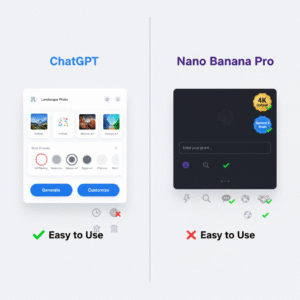
Final Test Results: Nano Banana Pro Wins 7.5 to 2.5
What GPT Image 1.5 Does Well
- Speed: Four times faster than previous versions
- English text: Generally solid accuracy
- User interface: Predefined templates help beginners
- Accessibility: Lower learning curve for new users
- Integration: Works within the broader ChatGPT ecosystem
Where GPT Image 1.5 Struggles
- Hindi and multilingual text: Inconsistent rendering
- Cultural context: Misses nuanced cultural requirements
- Complex prompts: May omit or misinterpret details
- Facial consistency: Lost during progressive edits
- Anatomical accuracy: Unexplained elements appear
What Nano Banana Pro Does Well
- Cultural understanding: Grasps franchises, brands, and cultural contexts
- Multilingual accuracy: Clean Hindi, Japanese, and other scripts
- Output quality: 4K resolution for professional use
- Design sensibility: Better interpretation of aesthetic requirements
- Contextual intelligence: The Gemini 3 brain makes a difference
Where Nano Banana Pro Struggles
- User interface: No templates or guided workflows
- Learning curve: Requires prompt engineering knowledge
- Counting: Failed the grid test just like GPT
- Accessibility: Less beginner-friendly overall
Conclusion
After conducting ten rigorous tests across diverse use cases, the GPT Image 1.5 vs Nano Banana Pro comparison delivers a clear verdict: Nano Banana Pro wins with 7.5 points against GPT's 2.5.
This doesn't mean GPT Image 1.5 is a poor tool. Its speed improvements are real, English text handling is solid, and the user interface genuinely helps beginners create content quickly. For simple English-language projects with straightforward requirements, it performs adequately.
However, for anything involving cultural context, multilingual text, high-resolution output, or complex prompt interpretation, Nano Banana Pro consistently delivers superior results. The Gemini 3 brain powering Nano demonstrates genuine understanding—not just of pixels, but of what Avatar looks like, how an Aadhaar card should appear, and what minimalist design actually means.
If you're choosing between these tools for professional work, multilingual content, or projects requiring cultural sensitivity, Nano Banana Pro is the clear choice for 2025. Try both tools with your specific use cases and see which one delivers the results you need.